
Dealing with a Torn CCL in a K9 Search Dog- Part III: Bailey’s Surgeries
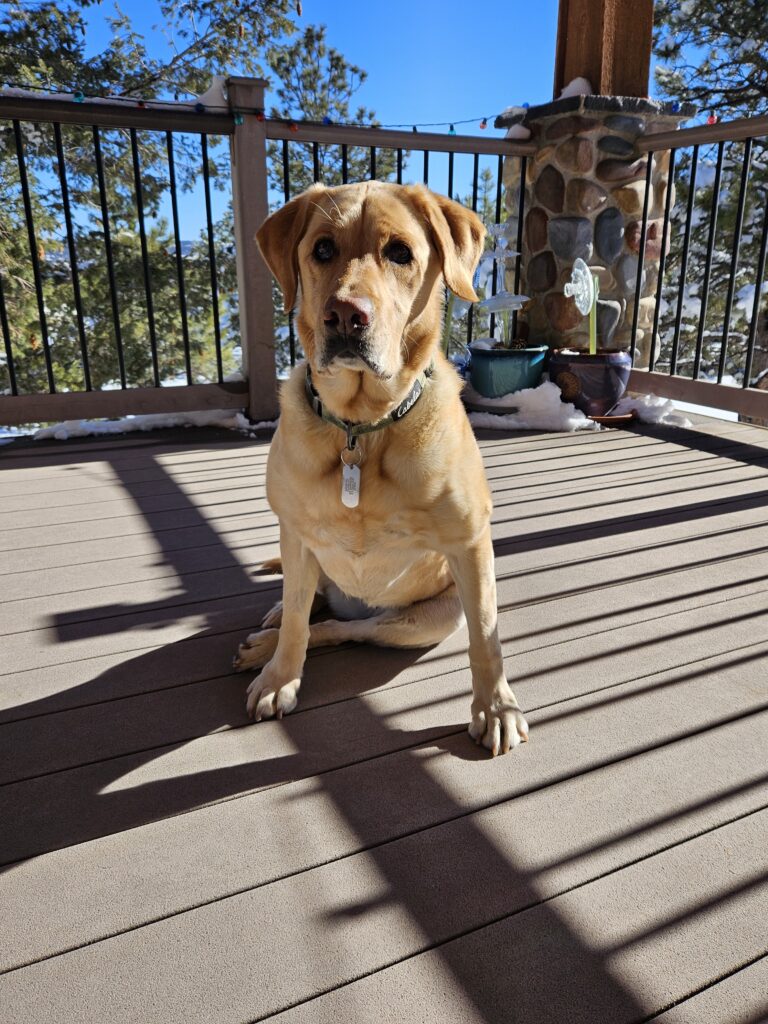
In Part III of a series that discusses a SAR K9 team’s months-long process of dealing with my 5-year-old, high-energy Labrador Retriever, Bailey, that suffered a Cranial Cruciate Ligament (similar to the ACL in humans) rupture, I cover weeks nine through her date for the hip dysplasia surgery. Part I & Part II addressed the road from Bailey’s initial limping through week 8 of recovery/rehabilitation.
Bailey’s recovery and rehabilitation for the CCL repair during weeks 1-8 went well. At the follow-up appointment, eight weeks post-surgery, we found Bailey’s knee had recovered as well as could be hoped. I had earlier mentioned the presence of hip dysplasia, so we made a consult appointment with Colorado Canine Orthopedics’ hip specialist. A week later, we were back with the recent x-rays displayed on the big screen.
In the previous two parts of this article, we covered that Bailey’s left CCL had ruptured and that the x-rays also showed dysplasia on the right side. In fact, at the initial veterinary appointment in November with the x-rays, the doctor noted the dysplasia on the right side but not the CCL rupture on the left. Why is she limping on the left if the dysplasia is on the right? Looking back, the limping and the dysplasia were on opposite sides, but I assumed the dysplasia was the cause of the limping (even though this made no sense…). At our first orthopedic appointment, the doctor cleared up my confusion. If your dog is limping badly on a rear leg, first assume a CCL injury is a candidate. Second, the ortho specialist could also see the more subtle signs of the CCL rupture on the x-rays—something the general practice vet missed. With multiple problems, the process is to fix the lower (closer to the ground) problem first; hence, the CCL surgery was scheduled first.
Bailey likely favored her left side due to the dysplasia on the right, eventually causing the degeneration of the CCL. With rehab (walks and hikes) continuing following the TPLO surgery, we next needed to address the dysplasia.
During his assessment in early March, the hip specialist noted that Bailey was already favoring her left side again, so clearly, the dysplasia was causing her discomfort. However, a labrador will never tell you this! His recommendation was to plan for a total hip replacement (THR) on the bad right side. There was no rush, but sometime within the next few months would be best. Considering calendars, vacations, etc., we scheduled her surgery in mid-May, about four months after her TPLO. THR surgery also has a very good success rate, and the recovery/rehab period is similar to that of TPLO surgery. The vet also noted some concerns about Bailey’s lower spine and recommended a consult with a neurology specialist in Parker, CO. We decided to face one problem at a time and look to just the THR surgery scheduled in May.
Meanwhile, we returned to K9 training. At our first training session in March, having done no training since November, I ran Bailey first on human remains. There were four sources placed within a one-acre area. I kept Bailey on her 30’ lead, gave her the “Bones” command, and off she went, dragging me along. She usually works HR pretty close to me, so I soon decided to take the lead off and hoped she would not break into a sprint. She got up to a trot but mainly stayed close and found her first source. I saw the nose pop, the trot into what I presumed was the source (not visible to me), and then she ran back to me, hit me on the hip, and ran back to the source. After four months of absolutely no search work, Bailey nailed her search and refind. After her reward of a couple of retrieves (previously, it would be 10-20 retrieves) and letting her savor her squeaky ball, we went back to work. She found a second source (elevated) quickly and again did her refind. At this point, 10-15 minutes into work, we finished and walked back to staging on lead.

The following week, we repeated the HR work, Bailey finding the four sources within about 20 minutes, with good refinds. Next was an area search with a subject. I had the subject hike to a hilly area less than a 1/4 mile away, so I knew the approximate location. I took Bailey a couple hundred yards away from the subject’s trail, scented her, and then started the area search towards the subject. We had a crosswind. Bailey typically works by making big loops about 100-150 yards in front of me, checking in periodically. In this case, she hit the scent below the subject and, once again, nailed her refind, and with a couple of prompts to “show me”, brought me back to the subject. The “work” part of this search was only 5-10 minutes. Though she trots or runs most of the time, I did not think it was excessive.
A week after the second training, we deployed to the adjacent county to support their Sheriff in an HR search. It was great to be mission-capable again! I limited Bailey’s off-lead work to a little over an hour. We had no luck in our assigned area, but one of our team’s dogs did make a find elsewhere.
Another Saturday training followed two weeks later (12 weeks post-surgery), with another area search and known subject location, about 1/4 mile from staging. I scented Bailey, and, as always, she was shot out of a cannon, starting her 100+ yard loops. I took her pretty much straight towards the subject, who was in a small valley below the ridge we were atop. We dropped into the valley early, and I worked Bailey up the valley. One of her loops got her in scent, and her find and refind followed. I was not concerned with my search strategy, just getting her into scent and not overdoing the working time. She made her find in about 15 minutes. I wish there were a “half-speed” button on her Garmin, but it is full-on when she is doing an area search.
We had added longer hikes back into our routine. Over the weeks, we got out almost daily and bumped the times up to 1:15-1:30 hours long. It was more and more like I had my dog back 100%, then I noticed she was looking like she was not comfortable getting up from a sit. Maybe I’ve pushed the hikes too far, too fast? Or, now that her left leg is fixed, is she putting some wear and tear on the troublesome right hip? With a few weeks to go until her scheduled total hip replacement, it seemed like a good time to cut the hike times and distances way back down. Twenty to thirty-minute hikes seemed safe.
When it rains, it pours. The shorter hikes aligned with a shoulder surgery I had in April (torn bicep tendon), so while I was in a sling, I rationalized being lazy and not doing the longer hikes. I also worked with Bailey on short/easy HR and article searches on my three-acre lot but did not continue the area search training.
With the limited training sessions, it is very nice to be partially back. Bailey was with her pack and did not miss a beat with regard to her alpha female role—once again explaining the proper K9 etiquette rules to the other dogs, especially the younger ones. Should a mission occur, I know I still need to limit her time-on-feet (time on paws?) for searches, but we can at least contribute again. Other SAR duties have pulled me away from many of the K9 training sessions, but if there is one takeaway, it is that Bailey has remembered the game. As a handler, I certainly need the training and working new problems, but Bailey does not need to stick to a weekly schedule.
The very limited training continued through April and into May. On the morning of May 17th, we were once again at CCO, dropping Bailey off for her total hip replacement surgery and, again, waiting for the telephone call to pick her up.
I will continue Bailey’s saga in Part IV, discussing her recovery and rehab following the THR surgery.